Help Shape the Future of Thunder Bay's Waterfront Trail
The City of Thunder Bay is developing a continuous waterfront trail connecting the north and south ends of the city, offering exciting new active transportation opportunities for residents and visitors. While portions of the Waterfront Trail have been constructed, there is still work to be done to achieve this vision.
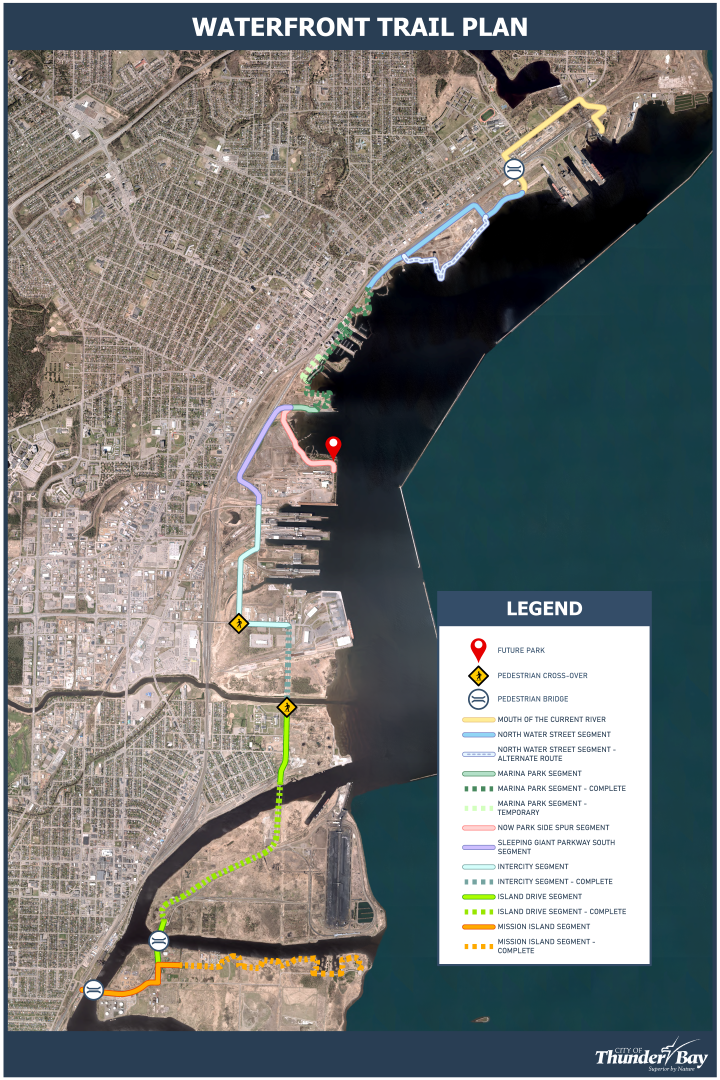
On this page, you can learn about the City’s long-term plan for this trail, view details of the planned route and completed sections, and stay up-to-date on opportunities to get involved.
Update: The 2026 waterfront trail survey has now closed. Results will be presented to City Council's Growth Standing Committee on June 16 (see details in the key dates section of this page).
The Planned Route
The City of Thunder Bay has a long-term plan to build a continuous waterfront trail. The planned route runs for approximately 13.5 kilometres, from Fisherman’s Park in the north to Mission Marsh Conservation Area in the south. It includes both separated and road-adjacent multi-use trails.
You can view detailed route maps in the Documents section of this page, showing planned and completed sections of the trail.
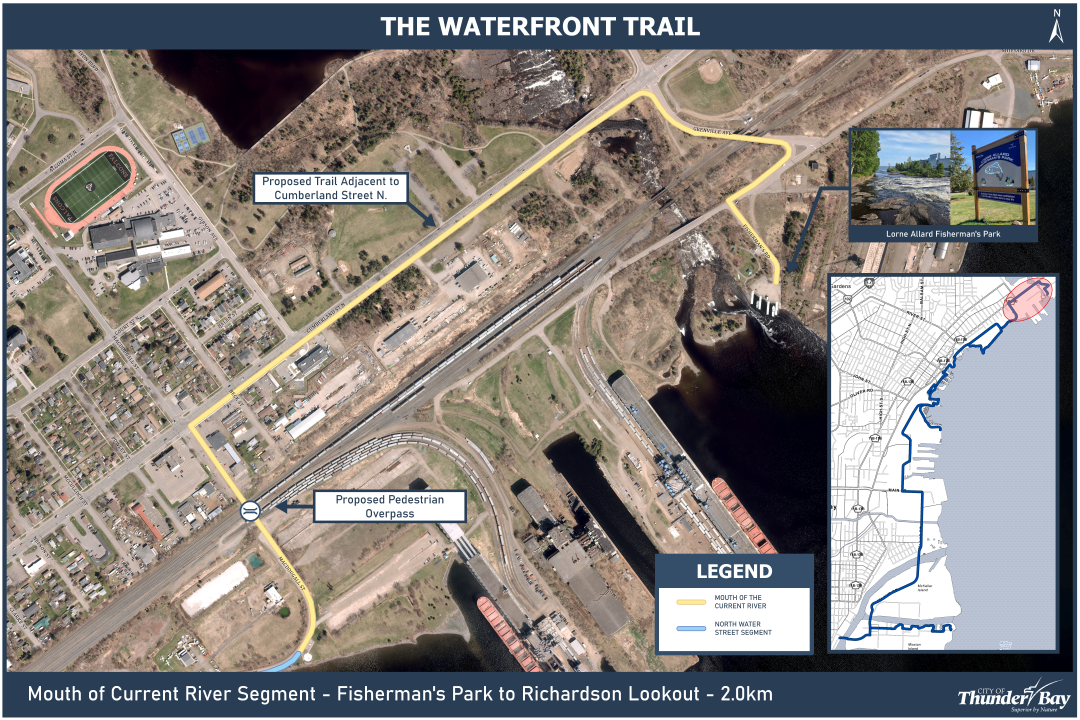
The planned route has recently been adjusted to direct pedestrians and cyclists from Marina Park Drive over a new railway overpass, onto MacDougall Street, then onto Cumberland Street North until it meets with the previously proposed trail section at Grenville Avenue. This is a change from the original proposed route along Shipyard Road through Richardson Terminal and continuing to Fisherman’s Park, which has been determined to be unfeasible. The map below shows the new proposed route in yellow.
Background
The Waterfront Trail vision dates back to the development of Prince Arthur’s Landing, as citizens and City leaders embraced a new focus on revitalizing Thunder Bay’s waterfront. In 2016, City Council adopted a long-term plan for a waterfront trail.
In 2021, City administration presented an update on the planned Waterfront Trail. This update included improvements to the preliminary design and changes to trail alignment, and outlined estimated costs and barriers including private property discussions and rail crossings.

-
Phone 807-625-3071 Email david.briand@thunderbay.ca -